
Case Studies

Examples of how operational digital twins help teams reduce risk and move faster.

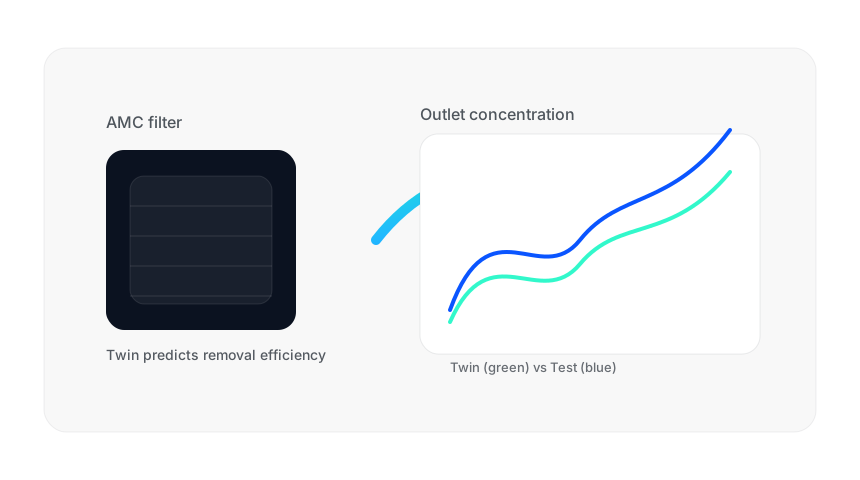
AMC filter digital twin diagram
AMC Filters Synthetic CFD Data Real-time Twin

Case Study: AMC filter digital twin for fast life-cycle prediction

An ML-powered digital twin built from validated physics models and synthetic CFD training data to predict filter performance and remaining useful life in seconds.

  • Problem: Experimental evaluation of filter performance is costly and slow, especially at low contaminant concentrations.
  • Approach: Generate synthetic datasets using CFD; extract reduced-order models (ROMs) for real-time operation; run what-if scenarios across inlet concentration (10–100 ppb) and flow (≈78–591 cfm).
  • Outcome: Instant predictions of outlet concentration and replacement timing, enabling preventative maintenance and faster iteration without months-long test cycles.
“Reduced-order models make real-time digital twins practical—without sacrificing physics.”
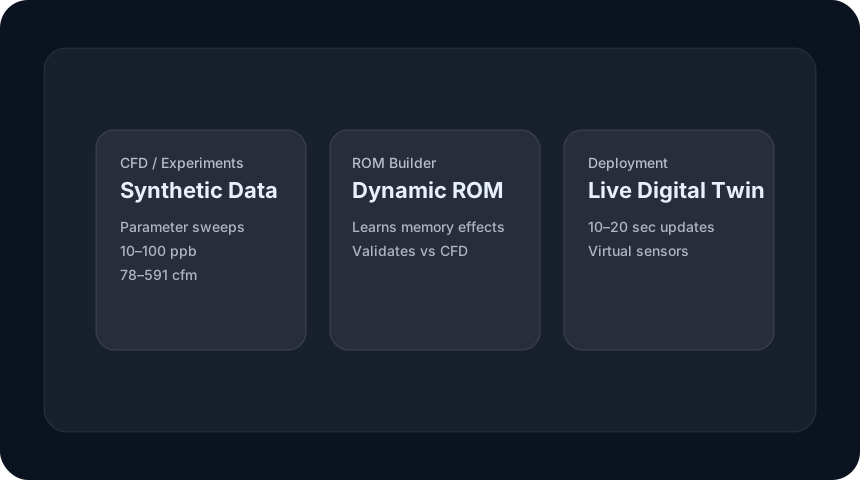
Dynamic ROM validation chart illustration
Dynamic ROM Validation Web Demo

Case Study: Validated dynamic ROM + web app for virtual sensors

A dynamic reduced-order model validated against CFD and live filter test data, then deployed as an interactive web application for operations teams.

  • Problem: Full CFD simulations can be accurate but too slow for operational decisioning.
  • Approach: Build a dynamic ROM (capturing memory effects/nonlinearity), validate against multiple scenarios, and surface predictions through a web UI with virtual sensors and outlet validation plots.
  • Outcome: Near real-time inference (seconds) with model behavior aligned to validated physics and lab test trends—supporting faster troubleshooting and proactive interventions.
“Operations gets instant visibility—engineering keeps the rigor through validation.”
More case studies coming soon.

Blog

Coming soon.

Coming Soon

Insights on smart fabs, physics-informed AI, and operational digital twins.